



Research Projects
Tensor-based Approach For Multichannel Biomedical Signal Decomposition
Signal decomposition is a crucial technique in the field of signal processing, which separates complex signals into simpler, more interpretable, and meaningful subcomponents. These subcomponents are often referred to as source signals, which can represent different features, properties, or aspects of the original signal. Signal decomposition enables researchers and engineers to gain deeper insight into the structure of a signal, thereby facilitating important tasks such as extracting essential information, removing noise or undesirable outliers, and simplifying subsequent analysis and processing.
In recent years, tensor decomposition has drawn significant attention from the signal processing and computer science communities due to its usefulness and effectiveness in analyzing high-dimensional, multi-way, and multivariate data. A tensor, fundamentally, is a multi-dimensional array, and tensor decomposition allows a tensor to be represented through more elementary components such as vectors, matrices, or tensors with simpler structures. Consequently, tensor decomposition has become a powerful and efficient tool for the analysis of multi-dimensional data.
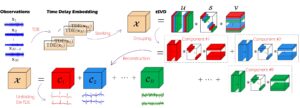
In this study, we propose a bridge between two problems: multichannel biomedical signal decomposition and tensor decomposition. By representing multichannel biomedical signals as high-order tensors, the signal decomposition task can be reformulated as a corresponding tensor decomposition problem. This transformation allows us to leverage recent advances in high-order tensor analysis to effectively address the challenges of multichannel biomedical signal decomposition.
Selected Publications
L.T. Thanh, K. Abed-Meraim, N.L. Trung, P. Ravier, O. Buttelli, A. Holobar. Tensor-based Higher-Order Multivariate Singular Spectrum Analysis and Applications to Multichannel Biomedical Signal Analysis. Signal Processing, 2025.
L.T. Thanh, K. Abed-Meraim, N.L. Trung. Higher-Order Singular Spectrum Analysis For Multichannel Biomedical Signal Analysis. European Signal Processing Conference (EUSIPCO), 2024.