
Research Projects
Signal and data processing for vital sign data
The outbreak of infectious diseases is threatening global health. Especially, in the South-East Asia region have been at serious risk. At mass gathering places, such as, airport quarantine facilities, public health centers, and hospital out patients units, rapid and highly reliable screening methods of infection are urgently needed during the epidemic season for preventing the spread of infection.
To meet this need, the University of Electronics and Communications (UEC) of Japan and partner institutions of UEC, National Hospital of Tropical Diseases, Hanoi (NHTD), and Tokyo Metropolitan University (TMU), have been developing multiple vital-signs based infection screening systems. This screening system monitors not only body temperature but also heart and respiration rates. However, accuracy of the data processing is not sufficient for the screening of the diseases for short time. This project is carried out in cooperation between the VNU University of Engineering and Technology (VNU-UET), Vietnam National University, Hanoi (VNU) and UEC.
The goal of this project is to develop signal and data processing method of the data from the multiple vital-sign-based infections screening system to improve the screening rate. To develop hazard map generating system, which predicts the area of infection diseases is the next target. The data will be provided by UEC to VNU-UET. The data processing methods include not only analog and digital signal processing methods but also the data processing by AI (Artificial Intelligence). Moreover, VNU-UET and UEC will collect the vital-sign data with the infection screening system and the ground-truth devices for Healthy subjects at VNU-UET, Vietnam.
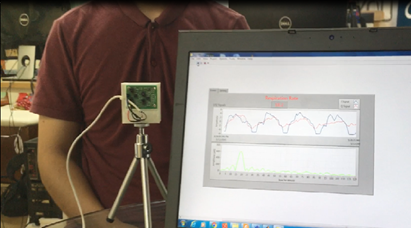
The heartbeat and respiratory signal acquired using Dopler radar
Selected publications
Yuki Iwata, Koichiro Ishibashi, Guanghao Sun, Manh Ha Luu, Thanh Han Trong, Nguyen Linh-Trung, and Tuan Do Trong. Contactless heartbeat detection from cw-doppler radar using windowed-singular spectrum analysis. In Annual International Conference of the IEEE Engineering in Medicine and Biology Society (EMBC), Montreal, Quebec, Canada, July 2020.
Nguyen Dinh Chinh, Luu Manh Ha, Guanghao Sun, Le Quoc Anh, Pham Viet Huong, Tran Anh Vu, Tran Trong Hieu, Tran Duc Tan, Nguyen Vu Trung, Koichiro Ishibashi, and Nguyen Linh Trung. Short time cardio-vascular pulses estimation for Dengue fever screening via continuous-wave Doppler radar using empirical mode decomposition and continuous wavelet transform. Biomedical Signal Processing and Control, 65:102361, March 2021.
Other information
PI: Prof. Koichiro Ishibashi, Assoc.Prof. Guanghao Sun
Co-PI: Dr. Luu Manh Ha, Dr. Dinh Tran Hiep