



Research Projects
Subspace Estimation and Tracking
Modern data analysis faces several challenges in real-life applications. Many real-life systems are required to make decision in (near) real-time while handling several streaming datasets in parallel. In many practical applications, impulsive noise and outliers appear in the data. Tensor datasets are expected to bring more versatile representation than conventional vector or matrix datasets, at the expense of high computational complexity. How to efficiently fuse data from several large-scale high-dimensional streaming data sources?
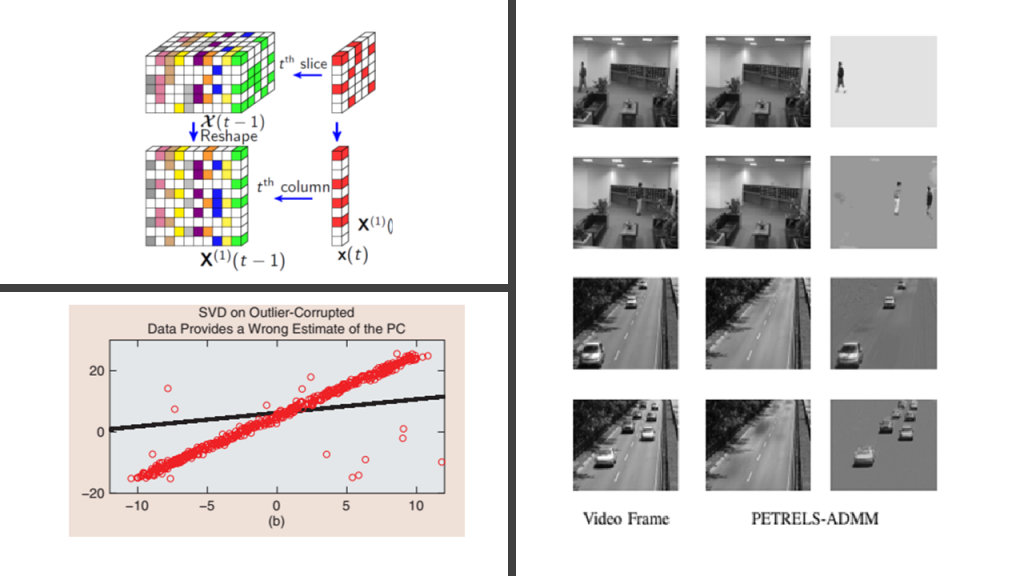
In data analysis, principal component analysis (PCA) is widely used for extracting low-dimensional subspaces from high-dimensional data. Subspace tracking, an important class of PCA, has drawn much attention. It is well-known that PCA is very sensitive to impulsive noise and outliers. PCA for impulsive noise and outliers is robust PCA. Robust PCA for streaming data is robust subspace tracking and is much more difficult.
The project aims to develop efficient data fusion methods and algorithms based on robust subspace tracking, for high-dimensional streaming data from several relevant sources affected by impulsive noise and outliers. We approach robust structured subspace tracking. Structured subspace tracking facilitates us to fuse data. When used with robust techniques, it helps deal with impulsive noise and outliers. We also want to illustrate and validate the developed methods and algorithms in biomedical signal processing and communications.
Selected Publications
Ta Giang Thuy Loan, Nguyen Hoang-Lan, Nguyen Thi Ngoc Lan, Do Hai Son, Tran Thi Thuy Quynh, Karim Abed-Meraim, Nguyen Linh Trung, Le Trung Thanh. Robust Sparse Subspace Tracking from Corrupted Data Observations. 24th International Symposium on Communications and Information Technologies (ISCIT), 2025.
Le Trung Thanh, Karim Abed-Meraim, Nguyen Linh Trung, Adel Hafiane. OPIT: A Simple but Effective Method for Sparse Subspace Tracking in High-dimension and Low-sample-size Context. IEEE Transactions on Signal Processing (TSP), 2024. [MATLAB Code].
Le Trung Thanh, Aref Miri Rekavandi, Abd-Krim Seghouane and Karim, Abed Meraim. Robust subspace tracking with contamination via alpha divergence. IEEE International Conference on Acoustics, Speech, and Signal Processing (ICASSP), 2023.[MATLAB Code].
Le Trung Thanh, Karim Abed Meraim, Adel Hafiance, and Nguyen Linh Trung. Sparse subspace tracking in high dimensions. IEEE International Conference on Acoustics, Speech, and Signal Processing (ICASSP), 2022. [MATLAB Code]
Nguyen Viet Dung, Nguyen Linh Trung, Karim Abed-Meraim, Robust subspace tracking algorithms using fast adaptive Mahalanobis distance. Elsevier Signal Processing (SP), 2022.
Le Trung Thanh, Nguyen Viet Dung, Nguyen Linh Trung and Abed-Meraim Karim. Robust Subspace Tracking with Missing Data and Outliers: Novel Algorithm with Convergence Guarantee. IEEE Transactions on Signal Processing (TSP), 2021. [MATLAB Code].
Le Trung Thanh and Nguyen, Viet Dung and Nguyen, Linh Trung and Karim, Abed Meraim.Robust subspace tracking with missing data and outliers via ADMM.European Signal Processing Conference (EUSIPCO), 2019. [MATLAB Code].
Nguyen Linh Trung, Viet-Dung Nguyen, Messaoud Thameri, Truong Minh-Chinh, Karim Abed-Meraim. Low-complexity adaptive algorithms for robust subspace tracking. IEEE Journal of Selected Topics in Signal Processing (JSTSP), 2018.
Viet-Dung Nguyen, Karim Abed-Meraim, Nguyen Linh-Trung, and Rodolphe Weber. Generalized minimum noise subspace for array processing. IEEE Transactions on Signal Processing, 65(14):3789–3802, July 2017.