



Research Projects
Efficient Tensor Decomposition
The rapid growth of high-dimensional data in scientific, engineering, and medical applications has created an increasing demand for efficient methods to represent, process, and analyze multi-way data. Tensor decomposition (TD) provides a powerful framework for extracting latent structures from tensors while preserving their inherent multi-dimensional relationships. By representing a high-order tensor using a set of lower-dimensional factors or cores, TD can substantially reduce data dimensionality and reveal meaningful underlying patterns. However, conventional tensor decomposition methods often face significant computational and memory challenges when dealing with large-scale, high-order, or dynamically evolving tensors.
Efficient tensor decomposition aims to address these challenges by developing algorithms that reduce computational complexity, memory consumption, and processing time while maintaining satisfactory decomposition accuracy. Several strategies have been explored, including exploiting tensor structure and sparsity, developing randomized and sampling-based algorithms, designing memory-efficient tensor networks, and employing parallel, distributed, or online optimization techniques.
Efficiency is particularly important in real-world applications where data are large, incomplete, noisy, or continuously generated. For example, medical imaging, hyperspectral imaging, video surveillance, sensor networks, and biomedical signal processing often involve high-dimensional tensors that cannot be efficiently handled using conventional batch decomposition methods. In these scenarios, efficient tensor decomposition methods can enable scalable data compression, latent feature extraction, reconstruction, denoising, and real-time analysis.
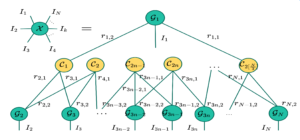
TriNet: A Novel and Memory-Efficient Tensor Network for Higher-order Tensor Decomposition, ICASSP 2026.
Selected Publications
Nguyen Thi Ngoc Lan, Le Trung Thanh, Nguyen Linh Trung, and Karim Abed-Meraim. TriNet: A Novel and Memory-Efficient Tensor Network for Higher-order Tensor Decomposition, 46th IEEE International Conference on Acoustics, Speech and Signal Processing, 2026.
Nguyen Quy Dang, Do Minh Nhat, Le Trung Thanh, Nguyen Linh Trung, and Karim Abed-Meraim. Fast and Robust Triple Tensor Decomposition With Data Corruption, 46th IEEE International Conference on Acoustics, Speech and Signal Processing, 2026.
Le Trung Thanh, Karim Abed-Meraim, Nguyen Linh Trung, and Adel Hafiane. Tracking Online Low-Rank Approximations of Higher-Order Incomplete Streaming Tensors, Cell Patterns, 2023.
Le Trung Thanh, Karim Abed-Meraim, Nguyen Linh Trung, and Adel Hafiane. A Fast Randomized Adaptive CP Decomposition for Streaming Tensors, 46th IEEE International Conference on Acoustics, Speech and Signal Processing, 2021.
Le Trung Thanh, Nguyen Linh Trung, Nguyen Viet Dung, and Karim Abed-Meraim. Three-way tensor decompositions: A generalized minimum noise subspace-based approach, REV Journal on Electronics and Communications, vol. 8, no.1–2, pp. 28–45, 2018.