
News & Events
AVITECH members win top prizes at the VNU University of Engineering and Technology Students Research Contest 2026
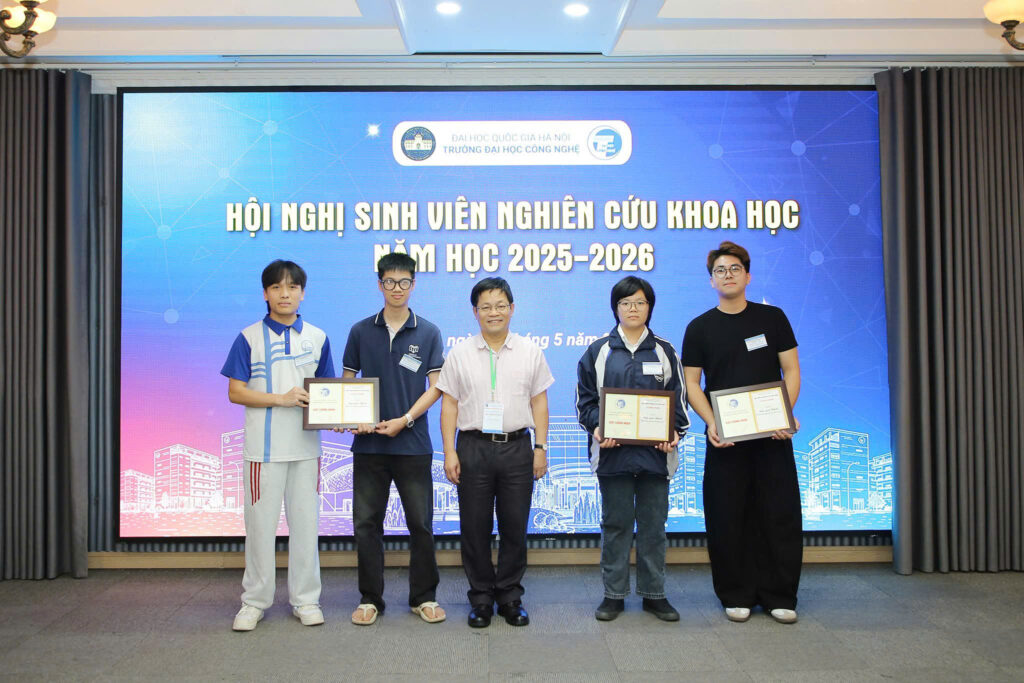
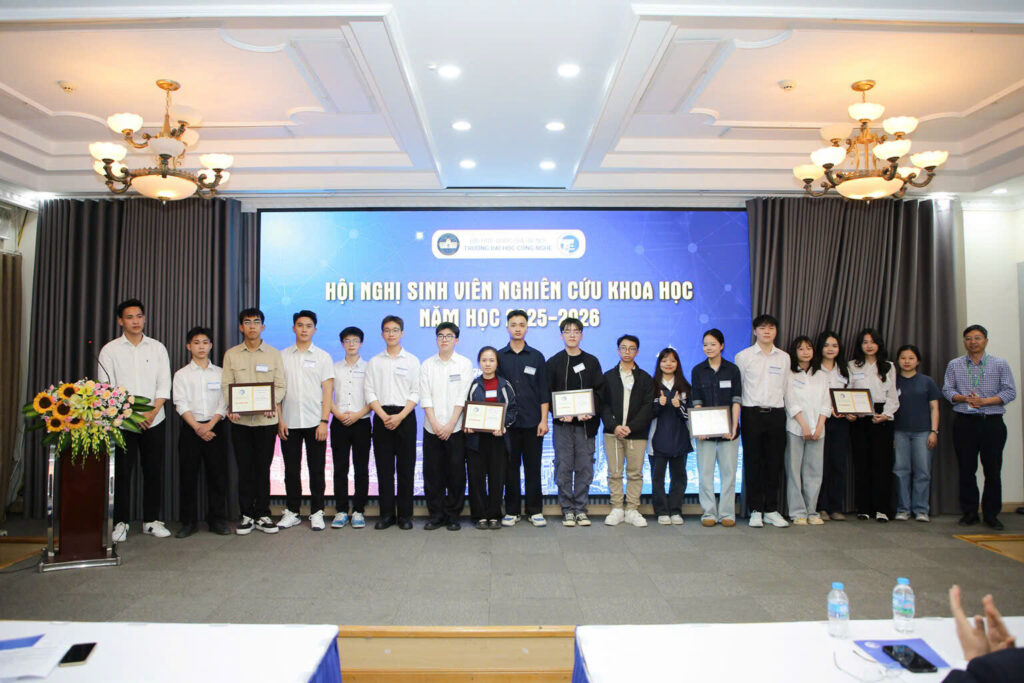
Nguyen Thi Ngoc Lan, Ta Giang Thuy Loan, and Nguyen Hoang Lan, under the scientific supervision of Dr. Le Trung Thanh, achieved outstanding results at the Students Research Contest 2026 of the VNU University of Engineering and Technology, winning one First Prize and one Second Prize, leaving a strong mark in artificial intelligence, signal processing, and data science.
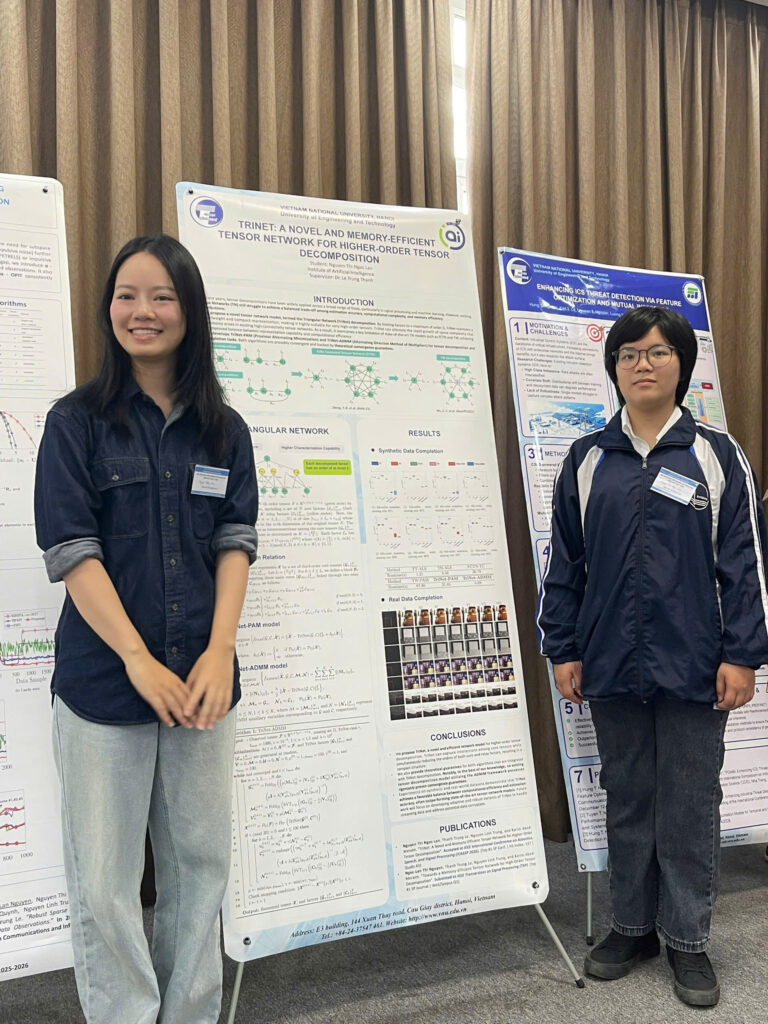
🏆 First Prize
As artificial intelligence increasingly has to process large-scale, multi-dimensional datasets, optimizing memory and computational cost has become a key challenge. Motivated by this need, the project proposes an entirely new tensor-network model for higher-order tensor decomposition with outstanding memory efficiency.
The highlight of TriNet is its ability to restructure multi-dimensional data through a new tensor-network architecture, significantly reducing the number of parameters and the storage footprint while preserving model accuracy. The method is especially suited to large-scale data problems such as image and video processing, biomedical signals (EEG, ECG), sensor data, and many modern AI applications.
Beyond its theoretical contribution to tensor decomposition, TriNet opens a new approach for building AI models that can handle large-scale data at a lower computational cost, laying the groundwork for practical applications in signal processing, data recovery, and the optimization of artificial-intelligence systems.
🥈 Second Prize
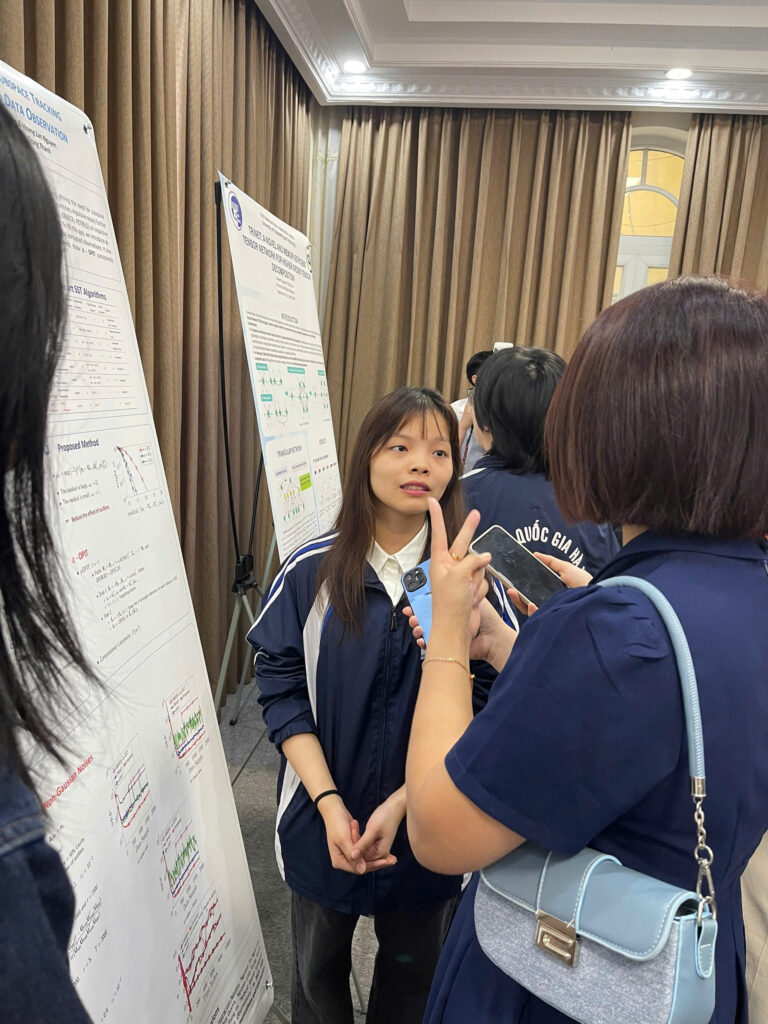
The project focuses on sparse subspace tracking from streaming data that is noisy and contains outliers, a problem of significant importance in signal processing, online machine learning, and real-time data analysis.
The team proposed the α-OPIT (Alpha Online Power Iteration via Thresholding) algorithm, developed on top of the OPIT method by incorporating α-divergence to improve robustness against non-Gaussian noise and outliers appearing in the data.
The algorithm estimates and tracks changes in the sparse subspace over time with high stability, computational efficiency, and adaptability to dynamic data environments. This is a promising research direction with applications in signal processing, computer vision, online learning, and real-time data-analysis systems.
See also: