
News & Events
Prof. Nguyen Linh Trung Presents at the “NATIONAL SCIENTIFIC CONFERENCE AI4Telecom”
Tuesday, October 20, 2026
On the morning of September 10, 2026, at the Posts and Telecommunications Institute of Technology (PTIT) in Hanoi, Prof. Nguyen Linh Trung (VNU University of Engineering and Technology) delivered an in-depth presentation on “AI for Telecom: Signal Processing Perspectives.” The talk not only provided a comprehensive overview of AI’s evolution in telecommunications but also unveiled groundbreaking research directions from the AVITECH Research Group.
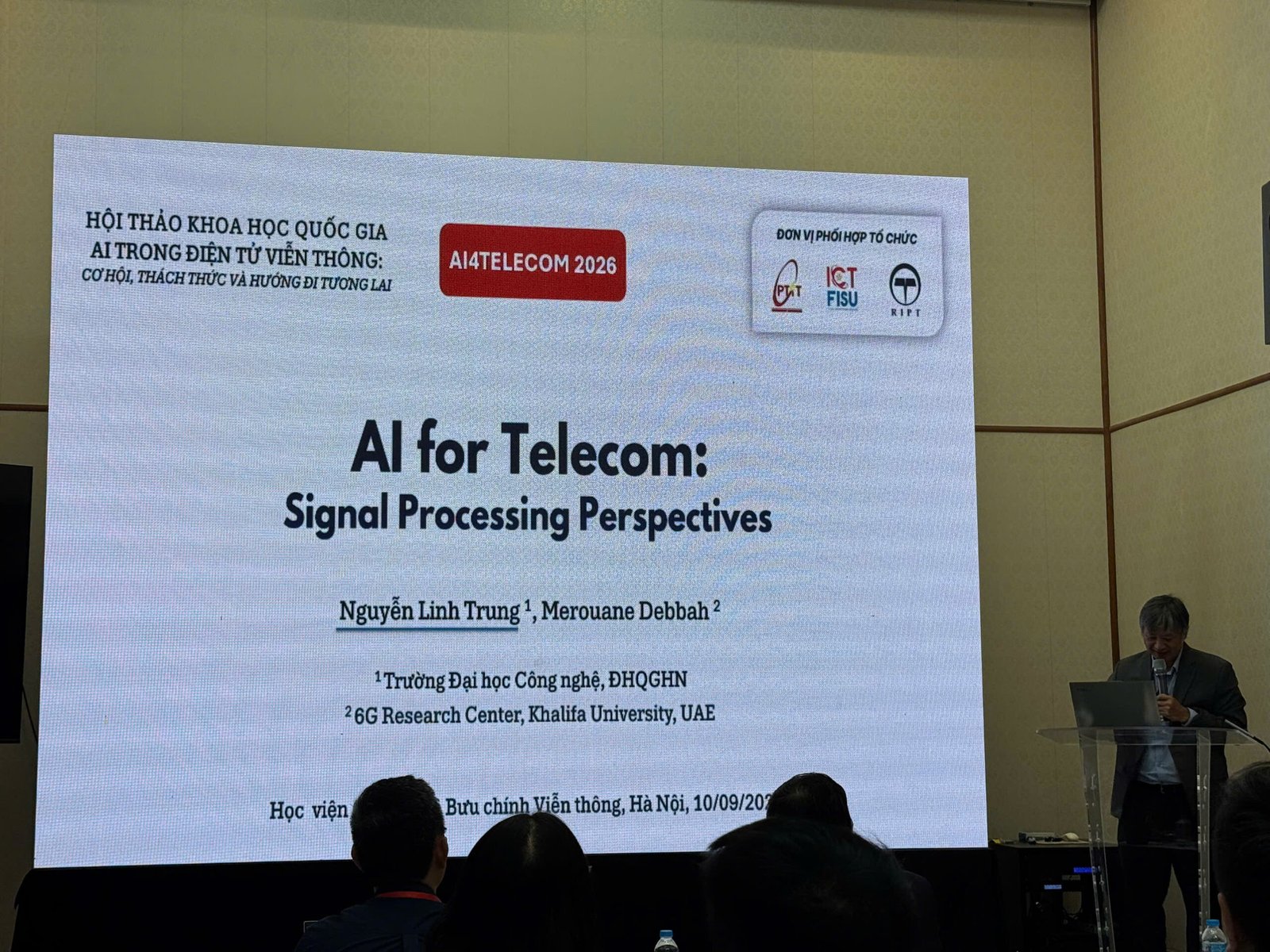
Prof. Nguyen Linh Trung presenting at the conference
The presentation was structured into two main parts. Part 1 introduced the concept of Large Perceptive Models (LPMs), building upon a previous report by Prof. Merouane Debbah (6G Research Center, Khalifa University). Part 2 showcased the group’s practical research, focusing on how AI is designed to replace or optimize specific Signal Processing (SP) tasks in telecommunications.
Part 1: The Journey from “Words” to “Worlds” via Large Perceptive Models (LPM)
Opening the first part, Prof. Trung outlined the evolution of AI in telecom across four distinct stages:
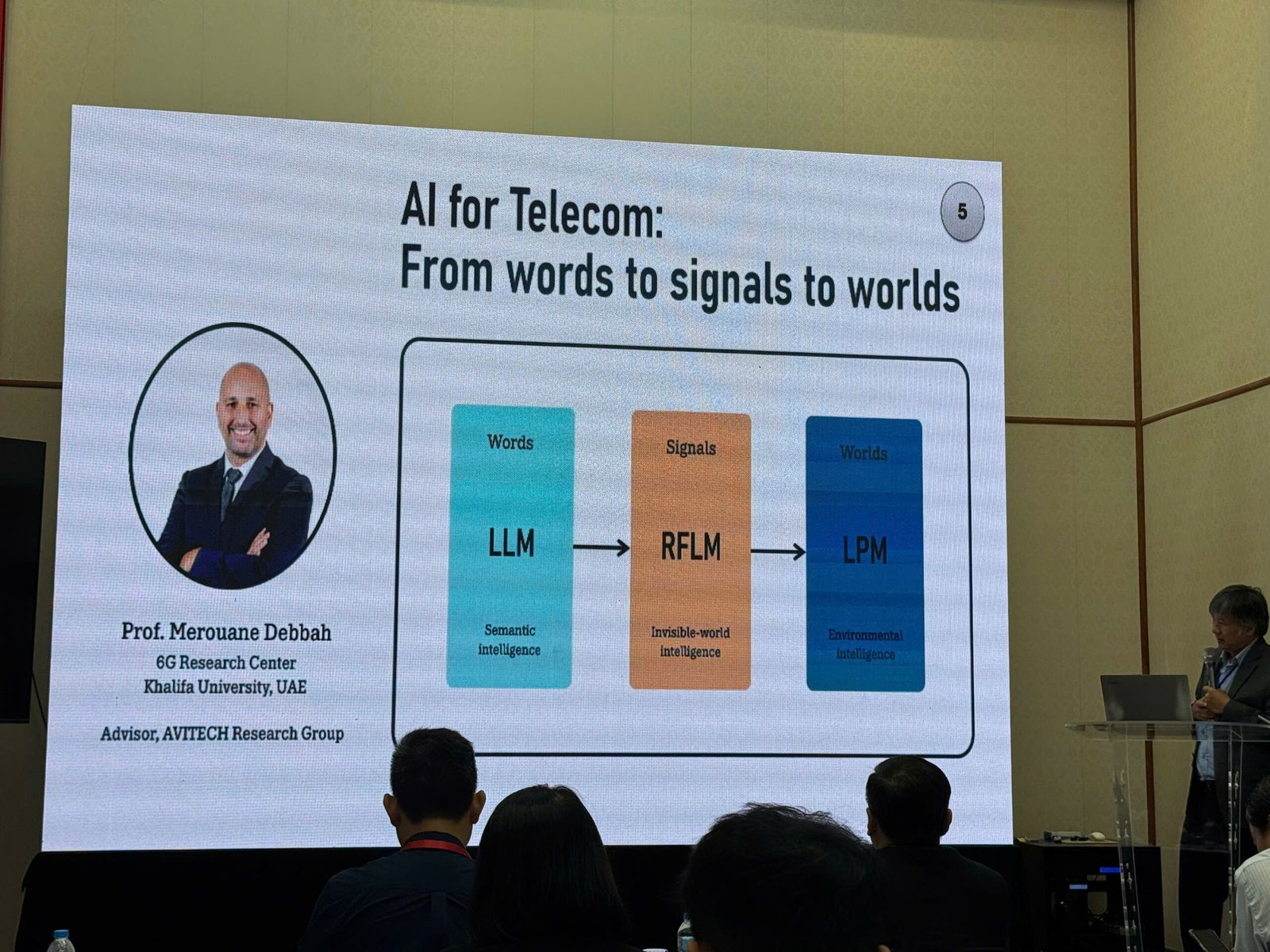
The evolution of AI in telecommunications across four distinct stages
- “Naive” Deep Learning: The early approach replaced the entire physical-layer transceiver chain with a deep neural network autoencoder for end-to-end communication optimization.
- LLM: TelecomGPT (Semantic Intelligence): A domain-adapted Large Language Model based on Llama3-8B, specifically fine-tuned to handle text-based telecom tasks and specialized industry knowledge.
- RF-GPT (Invisible-World Intelligence): By utilizing Short-Time Fourier Transform (STFT), raw RF signals are converted into visual spectrograms. This allows Vision-Language Models (VLMs) to “see” and interpret invisible wireless signals (such as 5G, Wi-Fi, and Bluetooth).
- LPM (Environmental Intelligence): The Large Perceptive Model acts as a “brain” that integrates multimodal data (pressure, smell, contact, sound, and RF signals) to perceive and interact with physical reality, proving highly beneficial for 6G and IoT systems.
This progression from Words → Signals → Worlds illustrates that AI is moving beyond text comprehension to perceiving the physical environment.
Part 2: AI Replacing Traditional Signal Processing Tasks
In the second part, Prof. Trung presented practical research from the AVITECH group, where AI models are deployed to replace or optimize complex signal processing tasks:
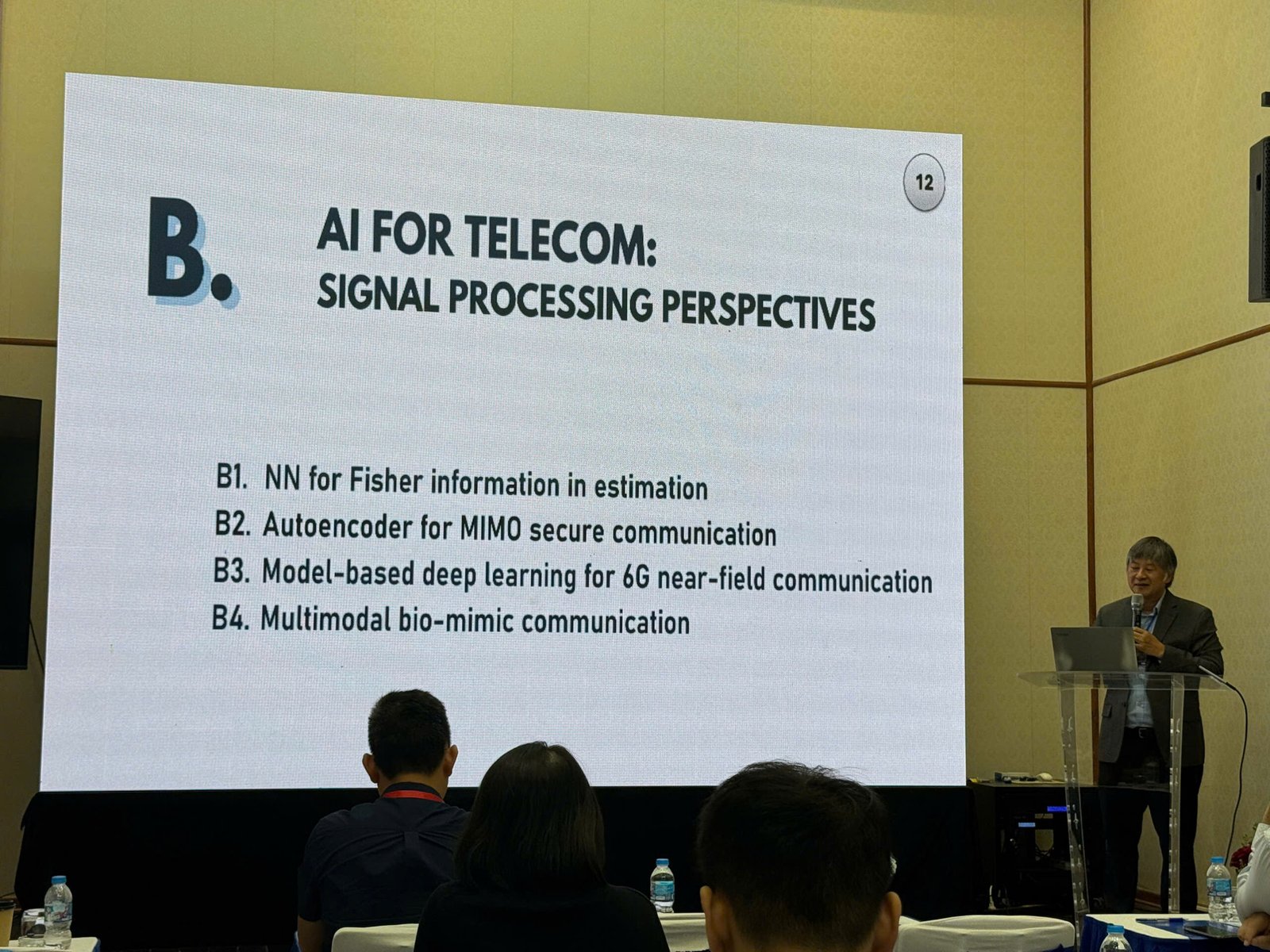
AI applications in replacing traditional Signal Processing tasks
- Fisher Information Estimation using Neural Networks (FINE): Instead of relying on complex analytical models, AI is used to learn Fisher information directly from data. This helps determine the Cramér-Rao Bound (CRB), a fundamental limit for evaluating estimation algorithms.
- Autoencoder for MIMO Secure Communication: Deep learning is applied to drive “Friendly Jamming” based on radar feedback. AI estimates Fisher information to optimally steer jamming signals, securing the link without needing the exact location or channel state of the eavesdropper (Eve).
- Model-based Deep Learning for 6G Near-field Communication: The group proposed the H-LISTA network (using Deep Unfolding) to solve channel estimation for Extremely Large-Scale Antenna Arrays (ELAA). By combining mathematical domain knowledge with deep learning, the model achieves faster convergence and reduced computational complexity.
- Multimodal Bio-mimic Communication: Aiming for ultra-low-power IoT devices, the research explores Spiking Neural Networks (SNNs) and Reservoir Neural Networks for energy-efficient semantic encoding and decoding.
Key Takeaways
Concluding the presentation, Prof. Trung highlighted eight core messages that redefine the future of AI in telecommunications:
- LLMs were the first chapter, not the whole book.
- LPM extends AI from text to environments; IoT is a natural testbed for perceptive intelligence.
- RF-GPT shows that AI can learn to understand the invisible spectrum.
- The next frontier of AI is not only what machines can say — it is what machines can perceive.
- AI can be used to benchmark (AI) algorithms and evaluate system performances for better design and planning.
- Communication, sensing, and security can be learned jointly.
- Light-weight model-based DL models may be a potential solution for edge devices.
- Multimodal bio-mimic communication may be an alternative to LPM, serving as an energy-efficient approach for edge devices.
Prof. Nguyen Linh Trung’s presentation reaffirmed AVITECH’s pioneering position in seamlessly integrating traditional signal processing theories with modern AI models, opening promising avenues for 6G networks and beyond.
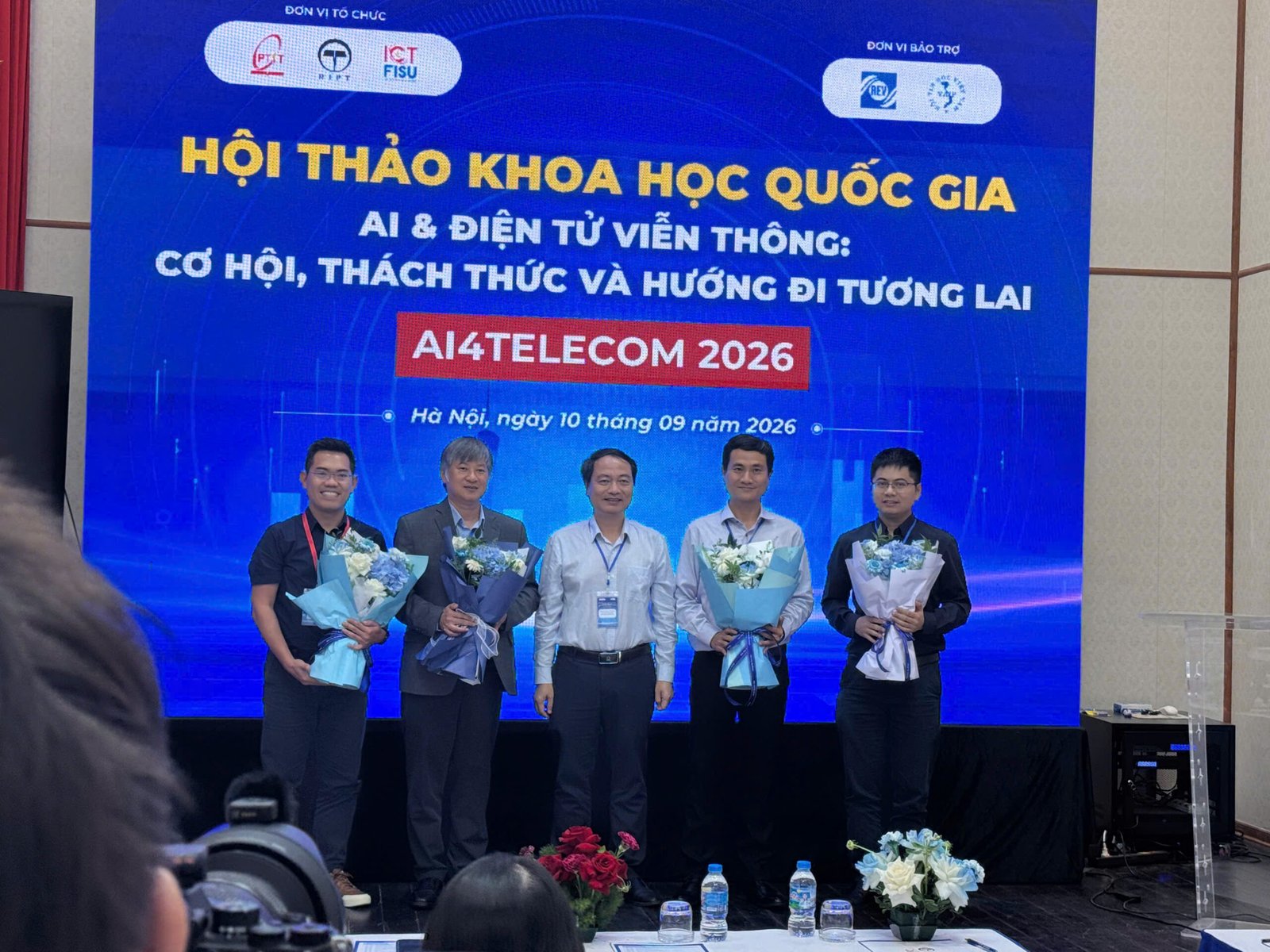
Prof. Nguyen Linh Trung taking a group photo with other speakers at the conference
Khang Nguyen